AI Is Advancing in Months, Not Years. Is Your Business Ready?
AI capability is improving in months, not years. The risk for small businesses is whether AI can still find them when customers ask.
By Heather Laskin · Published May 15, 2026 · Updated June 7, 2026
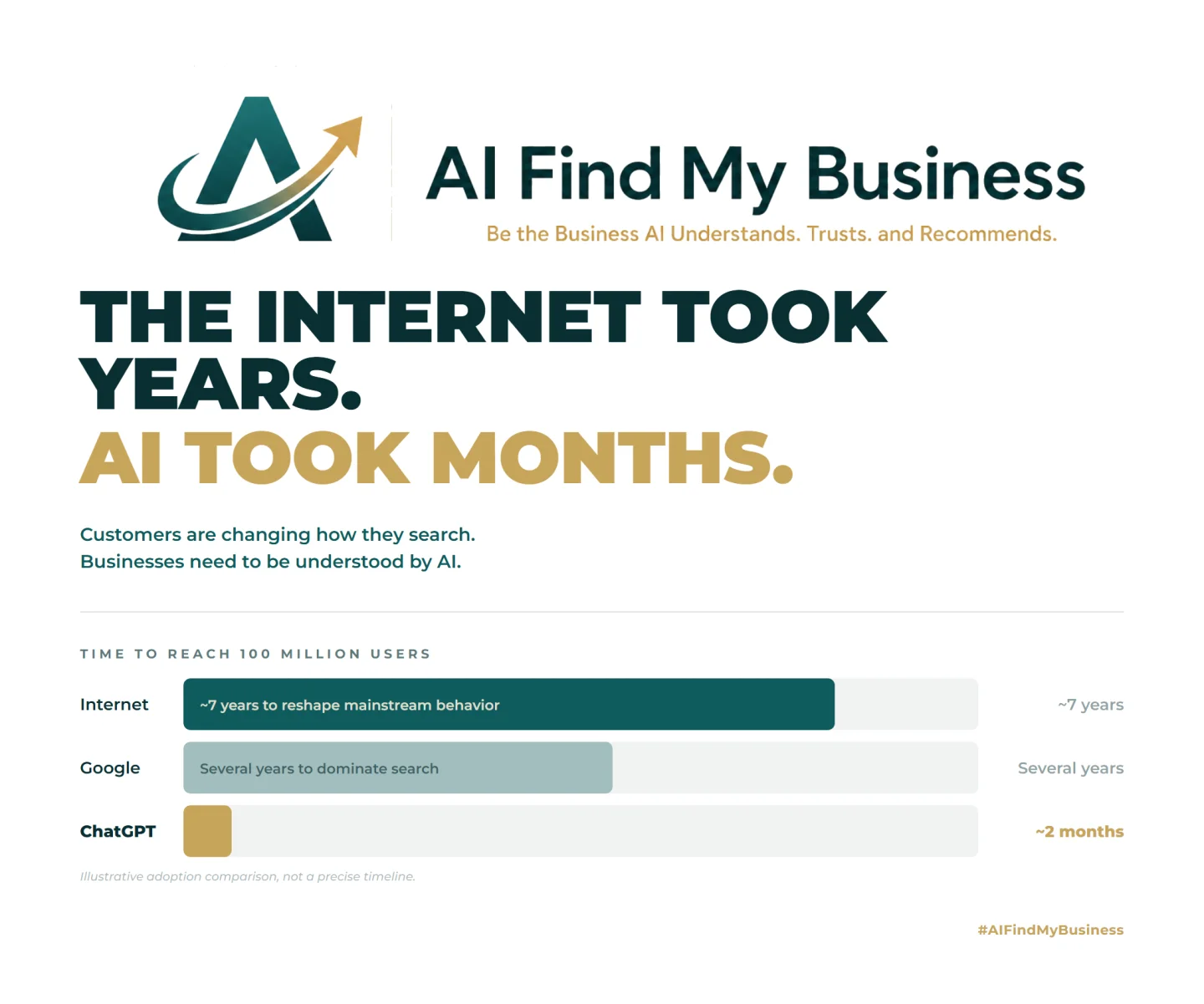
If technology is evolving at this pace, the businesses that adapt early don't just gain an advantage — they might be the ones that stay visible at all.
For years, most businesses have treated major technological change like something that happens gradually. A new platform emerges, industries adapt, and over time businesses adjust their strategy.
AI may not be following that pattern.
According to major 2026 research from organizations like Stanford's AI Index and the UK AI Security Institute, frontier AI capabilities are improving on timelines increasingly measured in months, not years. In some domains, capability growth is advancing fast enough that benchmarks are being saturated at a pace many businesses may not fully grasp.
The real risk may not simply be disruption. It may be how many businesses underestimate the speed at which discoverability itself can begin to change.
This distinction matters. When innovation compounds this quickly, the real risk may not simply be disruption. It may be how many businesses underestimate the speed at which consumer behavior, competitive landscapes, and discoverability itself can begin to change.
This is bigger than technology
For many business owners, AI still feels like a future operational tool. It's something connected to productivity, automation, or content. But AI's growth trajectory suggests something broader may already be happening.
As AI becomes more integrated into how people ask questions, seek recommendations, compare providers, and make decisions, businesses may need to think beyond how AI changes what happens inside their company. They may also need to consider how AI changes whether customers find them in the first place.
This is where the conversation becomes more urgent. If consumers increasingly rely on AI-driven tools for trusted starting points, recommendations, and guidance, then visibility may no longer be defined solely by websites, SEO, or traditional rankings. It may increasingly depend on whether AI has enough trustworthy, relevant, and credible information to confidently understand and surface a business when it matters.
The pace problem
Most businesses do not fail because they ignore change entirely. They often struggle because they underestimate how quickly change becomes relevant.
When capability cycles compress from years into months, adaptation windows may shrink too. Strategies that once felt proactive can become reactive faster than expected. This does not mean every business needs to panic — it just means businesses should be paying closer attention.
The companies that recognize meaningful shifts early are often the ones best positioned to adapt before the market fully recalibrates around them.
What "months, not years" looks like in practice
You don't have to track frontier research to feel this. Benchmarks that took years to beat are now being saturated in a quarter. Assistants that couldn't reliably recommend a local business a year ago now do it conversationally, with names and reasons. And the share of buyers who open an AI assistant before a search engine keeps climbing. The signal most owners actually notice is simpler: how often a customer conversation now starts with "I asked AI and it suggested…"
What should businesses be asking?
Beyond "how do we use AI?", these are the questions that matter now:
- How is AI changing customer expectations?
- How are people discovering businesses differently?
- Does AI understand our business clearly enough to surface it?
- Are we prepared if discoverability changes faster than expected?
AI capability growth is no longer just a technology headline. It may be an early signal that the systems shaping how consumers discover, evaluate, and trust businesses could evolve faster than many expect.
The question is not whether every prediction will happen exactly as forecasted. The question is whether businesses can afford to prepare too slowly if the pace of change is already accelerating.
What to do this quarter
You don't need to predict the curve to stay ahead of it — you need to check where you stand and keep checking. Start by seeing how the AI engines your customers use describe your business today (our AI Visibility Checklist walks through the DIY version), fix the signals that are wrong or missing, and re-check on a cadence rather than once. In a fast-moving market, the businesses that look early and adjust often are the ones that stay visible.
In a world where AI is advancing in months, not years, the businesses that adapt early may not just gain an advantage — they may be the ones best positioned to stay visible at all.